
Garfield County Court Records After a Jail Arrest
For a Garfield County arrest, the court-record pathway is often the clearest official route. The arrest is the law-enforcement event, and booking is the custody event. Formal court records start when the Garfield County Prosecuting Attorney files a complaint, information, or other charging document in court. That distinction matters because a roster entry may list an arrest charge, warrant label, or hold, while the court file shows the charge the prosecutor actually filed and the case events that followed.
Use jail inmate records to confirm custody location, booking status, and whether the person may be held at Whitman County Jail or Walla Walla County Corrections Department. Use jail roster mugshots for the booking-photo side of the search. The court record is different: it tracks case number, charges, hearings, disposition, sentencing, and clerk-maintained filings. In Garfield County, that separation is especially important because no official Garfield-only jail roster was found in the research, but court records after a jail arrest may still exist locally.
How to Find Garfield County Court Records After an Arrest
Start with the statewide court portals and then narrow locally. Washington Courts case search is the broad public entry point for filed cases, while Odyssey Portal is another court-record search interface used for participating courts. Garfield County District Court is the likely local path for misdemeanors, gross misdemeanors, infractions, preliminary matters, and lower-court proceedings. The Garfield County Clerk is the Superior Court records and filing office for felony and Superior Court records.
The Washington Courts case-search portal is an official public entry point for filed case searches.
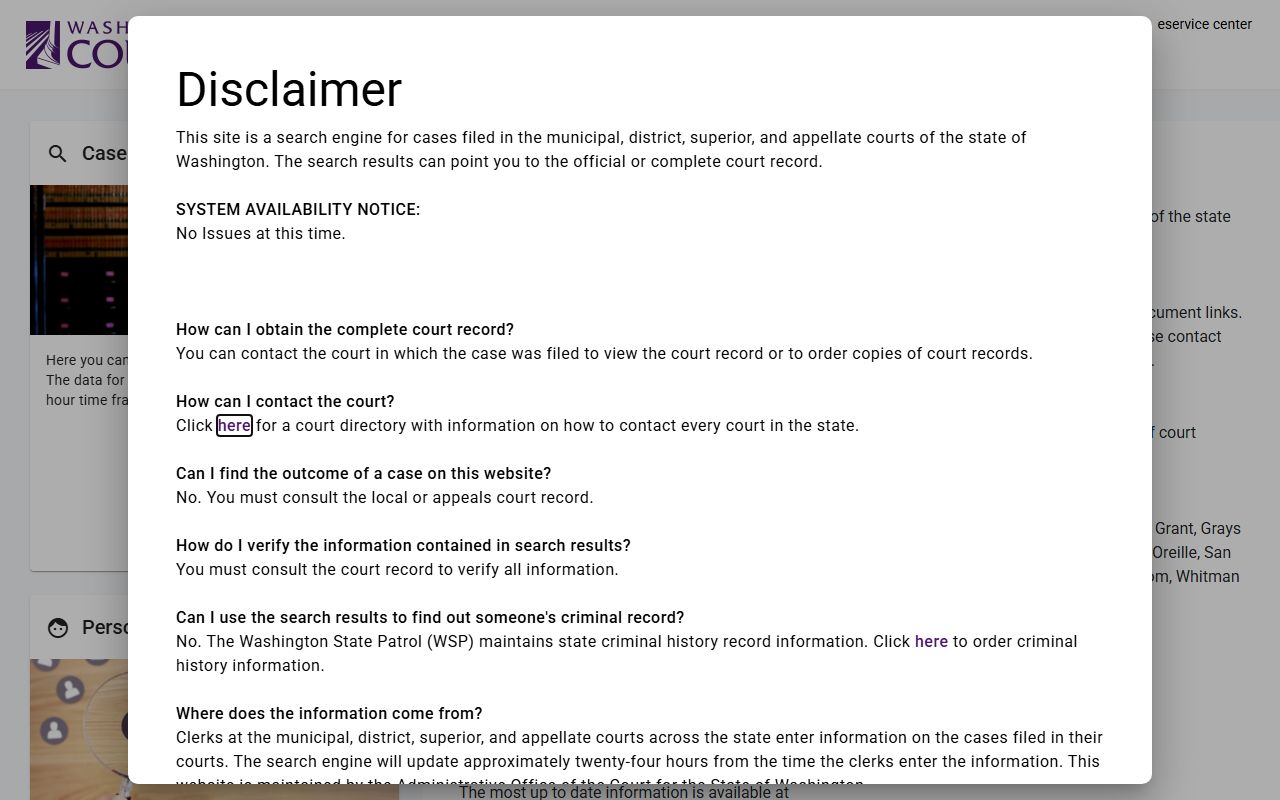
Use the portal as a case-finding tool, then verify copies and restricted records through the appropriate Garfield County court office.
- Gather the full legal name, approximate arrest date, date of birth if known, and any booking or court case number.
- Search Washington Courts by name first, then narrow to Garfield County, criminal case type, or a date range if the portal offers those filters.
- If a result appears, open the case and compare the filed charges with any jail roster charge or warrant hold.
- If no result appears, check Garfield County District Court and the Garfield County Clerk for local records access instructions, especially for older, newly filed, or restricted matters.
- For sentenced state-prison custody after conviction, use the Washington State Department of Corrections (DOC) locator rather than a county jail roster.
Washington criminal-history records are regulated by RCW 10.97. A court search is not the same as a certified criminal-history report. Court records show what a court case contains and how it ended; criminal-history dissemination follows separate state and federal rules.
Court Case-Search Fields for Garfield County Arrest Records
When searching court records after a jail arrest, use the fields documented in the research file rather than guessing from a roster. Exact spelling, case number, court selection, and date range can matter. Some search functions may vary by portal, and some functions may require an account or clerk contact for copies.
| Field Label | Type | Required | Options / Format Notes |
|---|---|---|---|
| Name Search | text | varies | Search by party name; exact spelling helps. |
| Case Number | text | optional if known | Best way to locate a specific case. |
| Court / County | dropdown/filter | optional or required depending portal | Select Garfield County or the relevant court if available. |
| Case Type | dropdown/filter | optional | Criminal, infraction, civil, or other categories may appear depending on the portal. |
| Date Range | date fields | optional | Useful when the name is common or the arrest date is known. |
| Search | button | n/a | Runs the query. |
| Reset / Clear | button | n/a | Clears the query. |
The Odyssey Portal may show case information for participating courts, but sealed and confidential records are not available through public search.
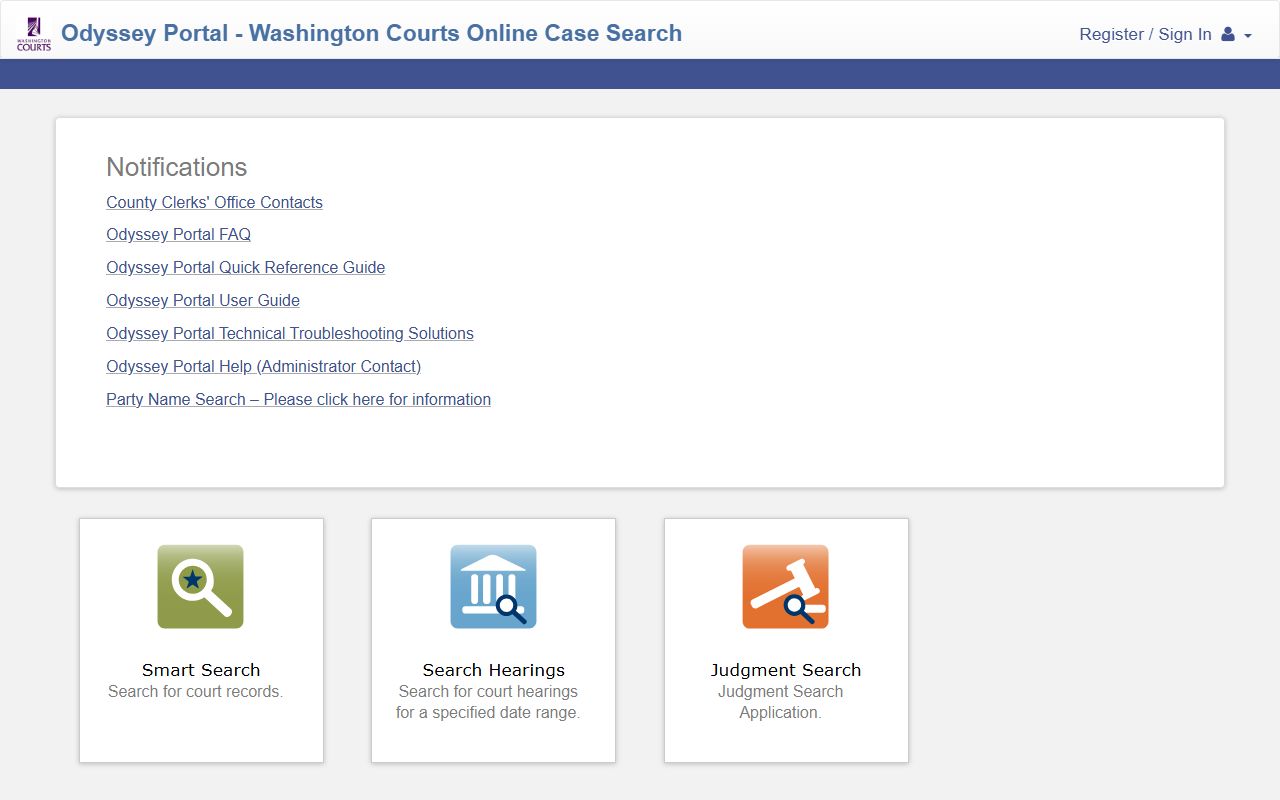
If a portal result is incomplete, the next step is a clerk request, not a third-party shortcut. The clerk can explain which copies are public, which fees apply, and which records are restricted by rule or statute.
How Charges Get Filed After an Arrest: Complaint, Information, and Indictment
After booking, law enforcement reports and probable-cause materials go to the prosecutor. The Garfield County Prosecuting Attorney decides whether to file charges, decline charges, amend them, or seek another outcome. The charging document is what turns the arrest event into a court case. The research identifies three charging-document types readers may encounter.
| Complaint | Information | Indictment | |
|---|---|---|---|
| Filed By | Usually a prosecutor, sometimes based on officer materials in lower-court practice. | Prosecuting attorney. | Grand jury. |
| Common For | Often begins a criminal prosecution, especially lower-court or early felony proceedings. | Many felony cases in Superior Court. | Serious felony matters, but not the ordinary route for most county cases. |
| Starts | The filed court case or early criminal proceeding. | The formal Superior Court charge. | A grand-jury charged case. |
| Garfield County Note | May appear after a District Court arrest path. | Often tied to the Clerk and Superior Court record path. | Do not assume indictment unless the court record says so. |
Garfield County Prosecuting Attorney
Washington counties use prosecuting attorneys, not district attorneys. The Garfield County Prosecuting Attorney is the office that decides which criminal charges to file after law enforcement submits reports. The research identifies Matt L. Newberg, also listed as Matthew Newberg, as the elected Prosecuting Attorney. The office may file a complaint or information, amend charges, decline charges, negotiate pleas, or dismiss charges depending on the evidence and law.
The Garfield County Prosecuting Attorney page identifies the local charging office for Garfield County criminal matters.
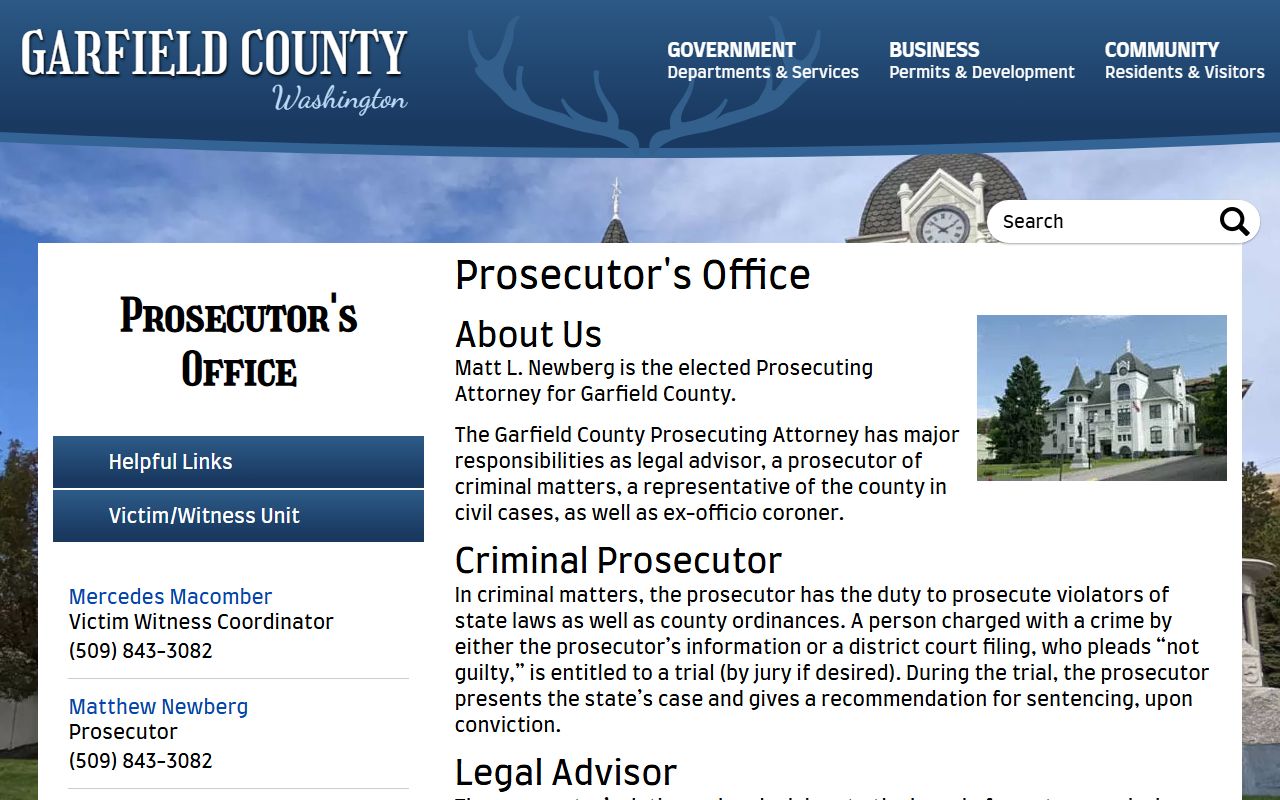
Use the prosecutor page to understand the charging office, but use the court file and clerk channels to confirm filed records and copies.
Prosecutor contact: Garfield County Prosecuting Attorney, Matt L. Newberg / Matthew Newberg, phone (509) 843-3082. The staff directory also lists Mercedes Macomber as Victim Witness Coordinator and Tina Warren as Office Manager under the same phone number.
Charge Status and What It Means
Charges can change as a case moves through court. A booking entry may show the arresting officer's probable-cause charge, a warrant description, or an agency hold. The court record shows prosecutor-filed charges and later status changes. In Garfield County, where the person may be held in another county jail, this comparison is especially important because the physical custody record and the filed court case may live in different systems.
| Status | What It Means |
|---|---|
| Pending | The charge or case has not reached final disposition. |
| Amended | The prosecutor changed the charge after filing. |
| Reduced | The charge was lowered to a lesser offense. |
| Dismissed | The charge ended without a conviction on that count. |
| Convicted / Guilty | A conviction was entered by plea or verdict. |
| Acquitted / Not Guilty | The defendant was found not guilty at trial. |
| Deferred / Diversion | The case is handled through a deferred or program-based outcome if allowed. |
Bond and Release After an Arrest
Washington allows several release outcomes after arrest: release on personal recognizance, cash bail, surety bond, conditional release, or no release on a particular hold. Garfield County readers should separate three things: the jail roster's listed bond, the court's release order, and any other agency hold. If a Garfield County arrestee is housed at Whitman County Jail or Walla Walla County Corrections Department, the payment counter and release processing may be handled by the holding jail, while the legal authority for bail comes from the court, warrant, or order.
| Bond Type | How It Works |
|---|---|
| Cash Bond | Money is paid directly to secure release and appearance. Confirm whether payment is accepted by the court, jail, or holding county facility. |
| Surety Bond | A bail bond company posts bond for a fee. Washington permits commercial bail bonding, but acceptance must be confirmed with the court or jail. |
| PR / Own Recognizance | The person is released on a promise to appear, often with conditions ordered by the court. |
| Conditional Release | Release may include no-contact orders, travel limits, reporting, or alcohol/drug restrictions. |
| No-Bond Hold | The person cannot be released on that hold, often because of a warrant, probation or DOC hold, or another agency hold. |
Before posting bond, confirm the physical custody location, the exact bail amount, whether multiple holds exist, and which payment forms are accepted. A Garfield County case can be bailable while another hold prevents release. Release also takes time after payment because jail staff must verify paperwork, check holds, process property, and complete release steps.
Warrants That Lead to an Arrest
No official Garfield County online active-warrant search was located in the research. The fallback channels are the Garfield County Sheriff's Office, Garfield County District Court, Garfield County Clerk/Superior Court, Washington Courts search, and direct contact with the court that may have issued the warrant. Do not rely on a third-party warrant site to decide whether a warrant is active or cleared.
| Warrant Type | Meaning |
|---|---|
| Arrest warrant | Authorizes law enforcement to arrest a person accused of an offense. |
| Bench warrant | Issued by a judge, often after failure to appear or failure to comply with a court order. |
| Search warrant | Authorizes search of a place or item and is not automatically an arrest-list entry. |
| Fugitive / out-of-county warrant | Another jurisdiction wants the person held or transferred. |
| DOC warrant / secretary's warrant | Washington DOC supervision-related custody order. |
If a person is arrested on a Garfield County warrant, the sheriff or arresting agency confirms the warrant, transports the person, and books them into the holding jail. Because Garfield County may use contract jail space, the custody roster may appear under Whitman County Jail or Walla Walla County Corrections Department. A warrant can also create a hold that prevents release even when a new charge has bail.
Charges vs. Convictions
An arrest and charge are not the same as a conviction. The Whitman County vendor-hosted roster materials cited in the research warn that jail detention is not conviction data. The same principle applies when reading court records after a Garfield County arrest: a filed charge is an accusation unless and until the court enters a conviction by plea or verdict.
| Charge | Conviction | |
|---|---|---|
| Stage | An accusation filed in court or listed at booking. | A final finding or plea entered in court. |
| Proof Level | Based on probable cause and charging decisions. | Requires a guilty plea or proof beyond a reasonable doubt at trial. |
| Public Record | Often public, but may be restricted, sealed, juvenile, or incomplete online. | Often public, but access can still depend on court rules and record restrictions. |
| Practical Use | Read with caution and compare against the latest court status. | Confirm through the court record, judgment, or certified criminal-history process. |
Sealed vs. Expunged Arrest Records
Washington records can be restricted by court order, juvenile-record law, criminal-history law, privacy rules, or public-records exemptions. The research specifically cites RCW 13.50 for juvenile records and RCW 10.97 for criminal-history record dissemination. Do not assume that a dismissed charge, sealed case, or juvenile matter will appear in public search results.
| Sealed | Expunged | |
|---|---|---|
| Visibility | Hidden from ordinary public access when a court order or law restricts the record. | Treated under the specific Washington process that applies to the record type; do not assume automatic destruction. |
| Law Enforcement | May still be available to courts, law enforcement, or agencies allowed by law. | Access depends on the governing statute, order, and record system. |
| Eligibility | Depends on case type, age, disposition, waiting period, and court order. | Depends on Washington law and the exact record requested. |
| Where to Ask | Contact the court clerk or an attorney for the case-specific process. | Use the court or agency that holds the record; ask for the legal basis if access is denied. |
Public Records and Clerk Requests After an Arrest
Court portals are useful for finding a case, but they are not the only records route. For court filings, judgments, docket entries, and Superior Court records, use the Garfield County Clerk. For District Court matters, use the Garfield County District Court. For sheriff records, arrest reports, booking-related documentation held by the sheriff, jail-transport records, or confirmation of the holding facility, use the county public-records path or the sheriff-specific public disclosure process documented in the research.
Washington's Public Records Act, RCW 42.56, generally requires public agencies to make non-exempt public records available for inspection and copying. RCW 70.48.100 governs the jail register. Public copies may still redact or withhold medical information, juvenile information, victim details, protected addresses, sealed records, investigative material, and confidential court records.
A strong request includes the full name, approximate arrest date, date of birth if known, case number or court number if known, arresting agency, and the document type requested. If the person was held outside Garfield County, identify whether the requested record belongs to Garfield County, Whitman County Jail, or Walla Walla County Corrections Department before sending the request.
Background Check Considerations
Casual court lookup, jail roster review, public-records copying, and a regulated background check are different tasks. A public court search can show filed charges and dispositions, but it may not be complete, certified, or suitable for screening decisions. Certified criminal-history or consumer-reporting uses must follow the laws that apply to the requester and purpose.
Important: This site is not a consumer reporting agency and court or custody information may not be used for FCRA-covered screening purposes.
Restricted Court Records After an Arrest in Garfield County
Some records will not appear in public search even when an arrest occurred. Juvenile matters, sealed cases, protected victim information, medical details, confidential addresses, and active investigative material may be withheld or redacted. Odyssey and statewide court search results can also be incomplete for older cases, restricted matters, or records that require direct clerk handling. When a case cannot be found online, the safest official route is to contact Garfield County District Court, the Garfield County Clerk, or the agency that created the specific record.